


When I look back at the evolution of secure networking, one truth stands out: applying Zero Trust to modern networks at scale is hard. When you are retrofitting legacy OT networks, it is even harder. And when you’re talking about deployment across massively distributed, mission-critical networks that don’t have reliable constant connectivity to the cloud — think maritime fleets, oil and gas operations, or DoD tactical systems — it’s exponentially harder.
That’s why the convergence of Invisinet’s Zero Trust security originally designed for tactical networks and the new fourth generation of Infrastructure as Code (IaC) is such a game changer. It’s the first time we’ve been able to bring agility, automation, and security into perfect alignment — even for networks that are disconnected, narrow-band or latency-laden, mobile or operating AI on the edge.
How We Got Here
Infrastructure as Code has been around for well over a decade — Keif Morris first coined the term back in 2011. But it wasn’t until the last few years that we’ve seen the technology mature enough to support enterprise-scale and air-gapped tactical deployments.
In its essence, IaC allows organizations to describe their infrastructure in code — defining the desired state of servers, firewalls, and networks in configuration files. Tools like Terraform, Ansible, and CloudFormation transformed the way teams deploy infrastructure, bringing consistency, automation, and auditability to what used to be manual, error-prone processes.
As someone who’s been on the front lines of secure networking for decades, I can say this: IaC doesn’t just speed things up — it changes the game entirely. It replaces uncertainty with determinism. It bakes compliance into every deployment. It bridges the gap between IT speed and operational integrity.
Why It Matters Now
Between 2020 and 2025, IaC underwent its own revolution. It adapted to meet the demands of OT and edge environments — systems where connectivity is intermittent, latency is high, and control is decentralized.
This fourth evolutionary phase of IaC introduced breakthroughs such as:
- Local reconciliation and pull-based models like GitOps and Kubernetes operators
- Embedded state management for offline operation
- API abstraction to accommodate OT and SDN
- Vault-integrated secrets and Zero Trust identity
- Artifact-based deployment using OCI bundles, MQTT, and event triggers
Together, these innovations turned IaC into a universal orchestration framework — one that can operate in disconnected or hybrid environments with the same predictability as a cloud deployment.
The Challenge We Faced at Invisinet
Our customers — particularly in defense, critical infrastructure, and complex enterprise networks — all share the same challenge: deploy Zero Trust faster, without breaking what already works.
Historically, that’s been tough. Standing up secure gateways or Zero Trust overlays required extensive manual work — weeks of effort, highly skilled engineers, and mounting costs. Worse yet, every deployment was slightly different, leading to inconsistency and risk.
I knew that if we couldn’t solve that problem, our clients would struggle to keep pace with the threat landscape.
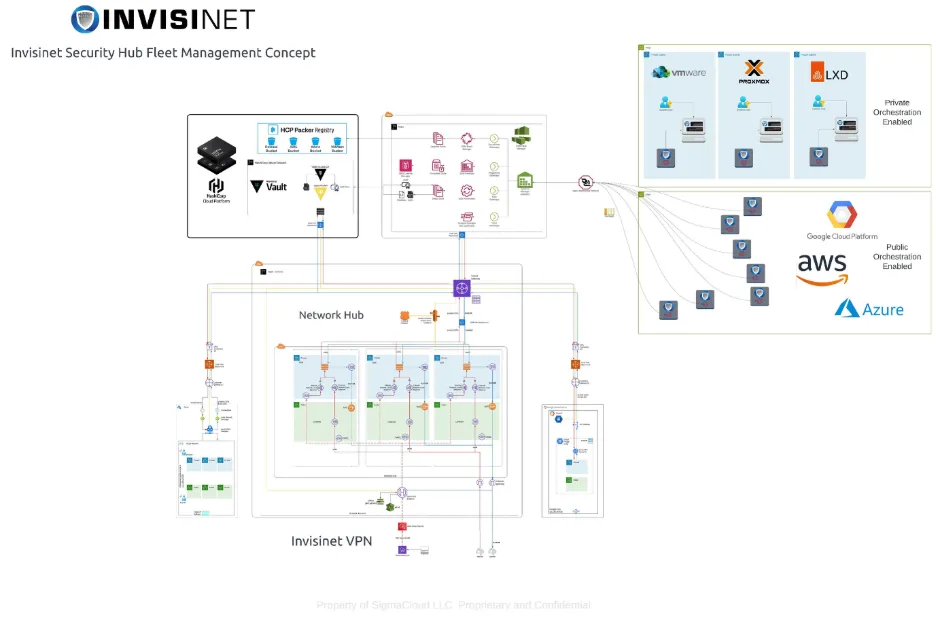
Our Breakthrough: Invisinet IaC, Powered by SigmaCloud
That’s where our partnership with SigmaCloud comes in. Together, we’ve built Invisinet Infrastructure as Code (IaC) 1.0, a fully embedded capability that automates secure network deployment from end to end.
With this integration, we’ve achieved something remarkable:
- Unified deployments — consistent across development, demo, and production, on-prem or multi-cloud
- Instant environments — Zero Trust proofs-of-concept that spin up in minutes and decommission cleanly
- Seamless CI/CD pipelines — aligning cybersecurity with modern DevOps workflows
- Compliance-as-Code — embedding frameworks like NIST 800-53 directly into every rollout
- Single-pane-of-glass management — making complex deployments executable with a single click
The Results Speak for Themselves
The early results have been nothing short of transformative:
- 99% faster deployments — from days to minutes
- Cost reduction — from ~$1,000 per instance to just ~$3
- Zero configuration errors — every deployment consistent, auditable, and repeatable
- Massive scalability — from one to over 1,000 gateways in under three minutes
- Freed IT resources — shifting teams from repetitive setup tasks to high-value security operations
These aren’t just metrics — they’re proof that secure automation can coexist with military-grade rigor.
Building the Future of Secure Deployment
To me, Invisinet IaC represents more than a technological milestone — it’s a strategic foundation for the future of Zero Trust.
We’re already advancing toward even greater capabilities, including:
- Desired-state reconciliation using Kubernetes, HashiCorp Vault, and Pulumi APIs
- Local control planes for disconnected operations
- Policy-as-Code integration for automated governance
- Edge-native orchestration and AI-driven optimization
Our mission is simple: create a deployment fabric where speed, security, and compliance move together — not in tradeoff, but in harmony.
This combination of local reconciliation, API abstraction, and secure state handling turned IaC from a cloud automation tool into a universal orchestration fabric — capable of managing:
- OT control systems (PLC gateways, industrial edge servers)
- Maritime and oil-rig compute nodes with intermittent links
- Satellite-connected or SCADA-secured networks
- Tactical or classified enclaves (air-gapped DoD / NATO networks)
From AI-driven optimization to deeper orchestration of complex hybrid environments, the future is about creating a deployment model where speed, security, and compliance move in lockstep.
See It in Action
This is the future I envisioned for Invisinet — where Zero Trust isn’t just secure, it’s simple. Where infrastructure doesn’t slow you down, it scales with you.
I invite you to see it for yourself.
👉 Request a demonstration of Invisinet IaC and experience firsthand how we’re redefining what’s possible for secure, scalable, and compliant deployments.
About the author

Brendan Sullivan, CEO of Invisinet, is an experienced technology executive specializing in emerging market tech and industry-level digital transformation where he combines his expertise in global network design, AI, and advanced cyber security. For the last 10 years he has been leading industrial mobility network operations as Viasat Enterprise’s CCO & SVP and RigNet Inc’s CIO & CTO